
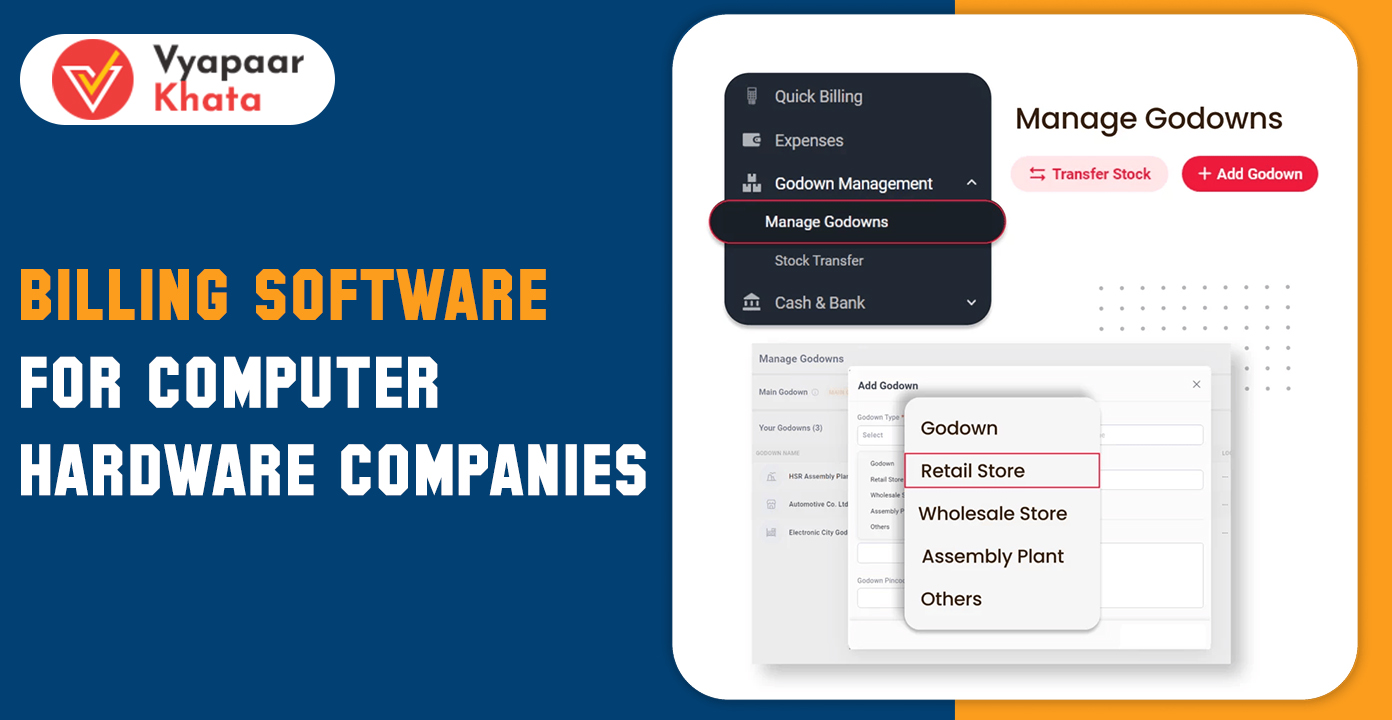
The computer hardware industry in India is growing rapidly due to rising digital adoption, remote work requirements, gaming culture, and continuous upgrades in IT infrastructure. From laptops and desktops to accessories, components, networking devices, and assembled PC parts—hardware sellers handle hundreds to thousands of SKUs with varying warranty timelines, serial numbers, and prices.
The industry operates at multiple levels—manufacturers, importers, distributors, wholesalers, retailers, corporate suppliers, and service/repair centers—each needing accurate and fast invoicing, stock tracking, and customer handling.
Why Billing Software Is Crucial
Manual billing systems fail to keep up with the speed and complexity of computer hardware operations. Businesses need billing software to:
- Generate GST-compliant invoices instantly
- Track items via serial numbers, IMEI codes, and unique barcodes
- Manage real-time inventory across multiple branches
- Handle warranty, AMC, and repair service orders
- Avoid pricing errors and mismatched stock
- Improve customer experience with faster checkout
Challenges in Manual Billing & Inventory Handling
Computer hardware businesses face several operational bottlenecks when using outdated or Excel-based systems:
- Difficulty tracking stock of thousands of components
- Errors in GST, tax calculations, and invoice print formats
- Inability to track serial numbers and warranty claims
- Mismanagement of parts used in repair and assembly
- No visibility of real-time stock when dealing with multiple branches
- Slower billing process leading to poor customer experience
- Hard to identify fast-moving or dead stock items
Billing software simplifies and automates all of these processes, making the business scalable and profitable.
What Is Billing Software for Computer Hardware Businesses?
Billing software for computer hardware businesses is a specialized solution designed to manage invoicing, inventory, serial numbers, warranty periods, repair/service job cards, and multi-channel sales for retailers, wholesalers, distributors, and service centers.
It is optimized for businesses dealing with laptops, desktops, components, accessories, and IT peripherals.
General Billing Software vs Hardware-Specific Software
| Feature | General Billing Software | Hardware-Specific Billing Software |
|---|---|---|
| Serial number tracking | Not | Detailed tracking for each item |
| Warranty & AMC | Basic | Automated reminders & logs |
| Repair/Service management | Not | Job cards, technician tracking |
| Inventory type | Simple | Multi-variant, bundled & component-level |
| Barcode/QR support | Limited | Essential for fast checkout |
| Multi-branch hardware needs | Minimal | Designed for distributors & IT dealers |
Modules Included
A complete hardware billing solution typically includes:
- GST Billing & E-invoicing
- Inventory & Stock Management
- Barcode / QR Code Management
- Serial Number & Warranty Tracking
- Repair & Service Center Module
- CRM & Customer History
- AMC (Annual Maintenance Contract)
- Purchase & Vendor Management
- Multi-User & Multi-Branch Access
- Cloud Sync / Offline Desktop Mode
- Financial Reports & Analytics
Key Problems Faced by Computer Hardware Companies
- Managing Large Inventory
Thousands of items such as laptops, SSDs, motherboards, RAM, gaming peripherals, networking devices, etc., require accurate categorization, variants, and real-time stock updates. - Tracking Serial Numbers & Warranty Status
Each hardware item has a unique serial number. Missing or incorrectly recording it creates warranty disputes and service issues. - GST Invoicing & Compliance
Hardware sellers must comply with GST, e-invoice, e-way bill, HSN codes, and tax slabs—manual errors lead to penalties. - Multi-Branch Management
Distributors and wholesalers require centralized dashboards to manage all branches with consistent pricing and stock visibility. - Repair & Service Center Job Cards
Service centers need a system to assign technicians, record parts used, track device history, and send delivery status notifications. - Bulk Purchase & Distributor-Level Pricing
Multiple pricing layers (dealer price, retail price, corporate price) require automated rate management. - Fast Checkout for Retail Stores
Computer stores require barcode-based quick billing with ready invoice types (estimate, sales, quotation, challan).
Essential Features of Billing Software for Computer Hardware Companies
GST-Compliant Invoicing
- Supports CGST, SGST, IGST auto-calculations
- E-invoice generation with IRN
- E-way bill generation for logistics
- HSN code-wise classification
- Multi-format invoices: Estimate, Tax Invoice, Proforma, Quotation
Inventory & Stock Management
- Real-time stock tracking across categories and branches
- Serial number / IMEI tracking for each item sold or purchased
- Minimum stock alerts to avoid out-of-stock situations
- Bundle product creation (e.g., desktop sets, assembled PCs with components)
- Purchase history tracking for each item
Barcode / QR Code Billing
- Barcode label creation and printing
- QR code generation for serial-based items
- Barcode scanning for quick checkout
- Reduced manual entry errors
- Faster counter operations
Repair & Service Center Management
- Create job cards with device details (brand, model, serial)
- Record problems reported by customers
- Assign work to technicians
- Track repair status: Pending → In Progress → Ready → Delivered
- Record parts used during repair
- Send SMS/WhatsApp delivery updates
Multi-Channel Sales Handling
- Manage both offline store + B2B orders
- Handle online marketplace orders (Amazon, Flipkart, IndiaMART – optional integration)
- POS billing for retail
- GST billing for bulk B2B clients
- Multi-rate support (dealer, distributor, MRP)
Customer Management & Warranty Tracking
- Maintain customer database with purchase history
- Auto warranty start date & expiry date
- Warranty claim reminders
- AMC (Annual Maintenance Contract) module
- Track repeat customers and service records
Purchase & Vendor Management
- Auto-GRN (Goods Received Note) from purchase invoice
- Supplier-wise price comparison
- Outstanding payment reconciliation
- Debit note & purchase return management
Financial Reports & Analytics
- Profit & Loss statements
- Stock valuation reports
- Fast-selling vs slow-moving items
- GST tax summary reports
- Branch-wise performance analytics
Multi-User & Multi-Branch Access
- Role-based access (Admin, Manager, Accountant, Sales Executive)
- Centralized dashboard for stock, sales & finance
- Individual branch billing with synchronized data
Cloud / Offline / Hybrid Deployment Options
- Cloud-based: Access from anywhere, automatic backup
- Offline desktop: Works without internet, ideal for local stores
- Hybrid: Syncs data when internet is available
- Supports Windows, macOS, web, and mobile (varies by software)
Types of Billing Software for the Computer Hardware Industry
Computer hardware businesses operate in different formats—retail shops, wholesale stores, distributors, B2B suppliers, and service/repair centers. Each format requires specialized billing features. Below are the major types of billing software built for the IT hardware industry:
Retail POS Billing Software
Designed for computer stores, laptop showrooms, and IT accessory shops, retail POS (Point of Sale) software helps in:
- Fast barcode-based billing
- Cash, UPI, card, and wallet payments
- Serial number & warranty capture during billing
- Exchange, returns, and credit note management
- Customer database with SMS/WhatsApp invoice sharing
Perfect for stores selling laptops, monitors, printers, gaming accessories, peripherals, and assembled computers.
Wholesale Billing Software
Made for IT wholesalers and large-volume dealers, this software includes:
- Bulk billing & bulk purchase invoice creation
- Tiered pricing (dealer price, distributor price, MRP)
- Dispatch challan, e-way bill, and GST-compliant invoices
- Purchase orders & material inward tracking
- MOQ-based pricing and rate contracts
Useful for businesses supplying hardware to retailers, companies, institutions, and resellers.
Distributor & Stockist Billing Software
Specially built for multi-branch distributors, C&F agents, and importers dealing in laptops, desktops, components, and networking devices.
Key functions include:
- Centralized inventory dashboard
- Multi-branch stock transfer
- Batch/serial number–level tracking
- Secondary sales tracking
- Scheme management for retailers
- Credit limit & outstanding tracking
Essential for brands and distributors handling high-volume stock movement.
Service Center Billing Software
For businesses running hardware repair/service centers, this software focuses on:
- Job card creation and device intake
- Technician assignment & service timelines
- Tracking parts used in repairs
- Warranty claim validation
- Customer communication on repair status
- Delivery receipts & service billing
Ideal for laptop repair centers, printer service shops, and motherboard repair labs.
Cloud-Based Billing Software
A flexible, modern solution that works across devices—PC, tablet, laptop, or mobile browser.
Benefits:
- Access from anywhere
- Auto-backup and real-time sync
- Multi-user support
- Zero maintenance & easy updates
- Works seamlessly for businesses with remote teams
ERP Billing for Large Hardware Companies
Enterprises dealing in manufacturing, assembling, corporate supply, or distribution need an ERP-grade system.
Key capabilities:
- Complete supply chain visibility
- Advanced procurement & vendor management
- Serial number–based production tracking
- Asset management
- Integrated finance, HR, and GST modules
- Multi-warehouse operations
Ideal for high-volume computer hardware distributors and assembling units.
How Billing Software Helps Computer Hardware Businesses
Billing software does much more than generate invoices—it strengthens the entire operational workflow of hardware companies.
Reduce Billing Errors
Manual entry mistakes in GST, serial numbers, or rates can cause financial loss. Automation ensures accurate invoices every time.
Faster Checkout
Barcode/QR-based billing reduces customer wait time, increases footfall handling capacity, and improves store experience.
Track Warranty Returns
Hardware items require warranty management. Software automates:
- Warranty start and end dates
- Serial-number records
- Warranty replacement tracking
Better Control Over Stock
Real-time visibility helps businesses know:
- Current stock
- Minimum stock alerts
- Fast-moving vs slow-moving items
- Component-level inventory for assembled PCs
Reduces Pilferage & Mismatched Inventory
Software-based stock audits reduce theft, missing parts, and billing manipulation—common issues in hardware retail and wholesale.
Improves Purchase Planning
Inventory history + sales trend analysis helps businesses restock the right items at the right time, preventing dead stock accumulation.
Enables GST Compliance
Automated GST, IGST, CGST, SGST calculation with:
- E-invoice integration
- E-way bill generation
- HSN code validation
- GSTR reports
Ensures hassle-free tax filing.
How to Choose the Best Billing Software for Your Store
Selecting the right billing software depends entirely on your business model. Consider the following factors:
Business Size
- Small retail stores → POS Billing
- Mid-sized wholesalers → Wholesale billing
- Multi-city distributors → ERP or multi-branch systems
- Service-oriented stores → Separate service center module
Inventory Type
Choose software that supports:
- Serial/IMEI tracking
- Bundled/assembled PC components
- Multi-brand hardware
- Repair parts tracking
Required Integrations
Depending on your business:
- GST e-invoice & e-way bill
- Online marketplace orders (optional)
- CRM tools
- Accounting software
- Service center module
Budget
Different pricing categories:
- Entry-level POS for ?500–?1500/month
- Mid-level wholesale/distributor software for ?1500–?4000/month
- ERP systems go higher based on modules
Choose based on ROI.
Cloud vs Offline
- Cloud: Best for multi-branch, remote access, zero maintenance
- Offline: Good for local shops with no stable internet
- Hybrid: Best of both worlds
Need for Service Center Module
If you repair laptops, printers, motherboards, or PCs, ensure your software includes:
- Job cards
- Technician assignment
- Repair tracking
- Part consumption log
Recommended Software – Vyaaparkhata
Vyaaparkhata is a prominent billing & invoicing solution widely used by computer hardware businesses.
It offers:
- GST billing
- Serial number tracking
- Inventory & purchase management
- Multi-user access
- Cloud + offline modes
- Barcode billing
- Service center module (optional)
Suitable for retailers, wholesalers, and distributors.
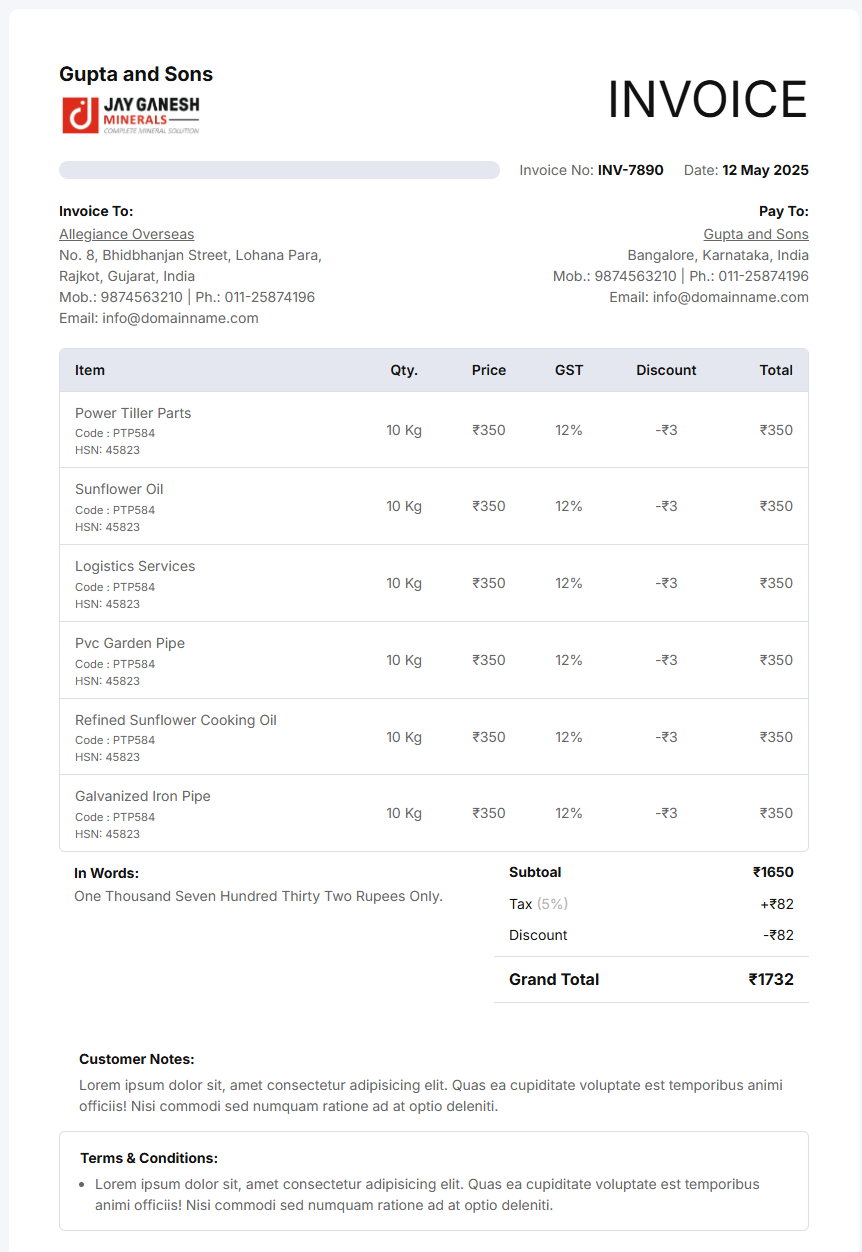
Future of Billing Software in the Computer Hardware Segment
Technology adoption in India’s IT hardware industry is accelerating. Billing software is evolving with new advancements:
1. AI-Based Stock Prediction
AI analyzes past sales, market trends, and seasonal patterns to:
- Predict future demand
- Prevent out-of-stock situations
- Reduce dead inventory
- Suggest optimal reordering quantity
2. Cloud-First Models
Future systems will be:
- Device-agnostic (mobile + web + app)
- Auto-updating
- Highly scalable for multi-branch operations
3. Automated Warranty Tracking
Software will auto-read:
- Serial numbers
- Warranty timelines
- Replacement eligibility
Future tools may connect directly with manufacturer warranty APIs.
4. Digital Receipts & UPI-Powered POS
- UPI QR for instant payments
- Digital receipts via SMS/WhatsApp
- Device-based billing (mobile POS)
- Tap-and-bill concepts for accessories
5. Integration With IoT & Cloud Hardware
Future billing systems may connect directly with smart shelves, sensors, and cloud-based stock counters.